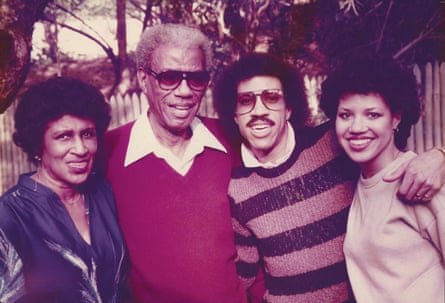
Most people know Lionel Richie as the voice behind “Hello” and “All Night Long.” But far fewer know the man who shaped the world he grew up in — his father, Lionel Richie Sr.
This article looks at who Lionel Richie Sr. was, what he did for a living, where the family lived, and how he quietly influenced one of the most successful music careers of the 20th century.
Who Lionel Richie Sr. Was
Lionel Brockman Richie Sr. was the father of singer, songwriter, and producer Lionel Brockman Richie Jr. The junior Richie was born on June 20, 1949, in Tuskegee, Alabama.
Lionel Sr. was married to Alberta R. Foster Richie, a teacher and school principal. Together, they raised their son in a household that valued education, community, and hard work.
The “Sr.” title exists simply to tell the two men apart. In nearly every public reference, “Lionel Richie” means the famous singer. His father is the quieter presence in the background of that story.
His Military Service and Professional Career
Multiple sources, including EBSCO Research Starters and People, describe Lionel Richie Sr. as a U.S. Army systems analyst. That role placed him in the technical side of military work rather than frontline service.
The Encyclopedia of Alabama refers to him as a retired Army captain. This is not a contradiction — it reflects his military rank, while the systems analyst description speaks to his professional function. The two details come from different sources and can reasonably be understood as complementary.
People, citing ABC News, also reported that Lionel Richie Sr. served as a Tuskegee Airman. The Tuskegee Airmen were the pioneering Black military aviators who trained at Tuskegee Army Air Field during World War II. It is a significant historical claim, and it is worth noting that People attributed it to ABC News rather than a primary military record. Without more detailed service documentation available in public reporting, this detail is best understood as reported — not yet fully confirmed through archival sources.
What is clear is that Lionel Sr. had a connection to the military world, carried a professional rank, and built a career that placed him firmly in a world of structure and responsibility.
Growing Up on the Tuskegee Campus
The Richie family lived on or near the campus of Tuskegee Institute, now known as Tuskegee University. This was not just an address — it was an environment that shaped everything around young Lionel.
Alberta worked as a teacher and later as a principal. Her husband’s military and technical background added another layer of discipline and expectation to the household. Between the two of them, education and purposeful work were constants in family life.
Growing up on a university campus during the civil-rights era meant that Lionel was surrounded by Black educators, intellectuals, students, and musicians from an early age. He had access to gospel music, jazz, and rhythm and blues in a setting that most children in ordinary neighborhoods would never encounter.
It was an unusually rich environment to grow up in. The campus gave him something that went beyond formal schooling — it gave him cultural exposure and a sense of what was possible.
A Father’s Expectations and a Son’s Career Choice
Lionel Richie attended Tuskegee Institute and, early on, seemed headed toward a more conventional path. He had interests in accounting and tennis, and there was every reason to expect he might follow the kind of stable, professional career his parents had built.
But music had other plans. When Lionel shifted his focus toward performing and eventually joined a band — what would become the Commodores — his father was reportedly displeased. According to The National, this disappointed Lionel Sr., who had likely imagined a more predictable future for his son.
It is worth being fair to Lionel Sr. here. His concern was not unusual for a parent watching a child walk away from a stable path toward something uncertain. He was not an obstacle to his son’s success. He was a father who valued security — and who, in the end, lived long enough to see his son become one of the most celebrated artists in the world.
The tension between the two was real, but it was never permanent. It was the kind of friction that exists in many families when a child chooses art over convention.
The Moment That Inspired “Three Times a Lady”
One of the clearest connections between Lionel Richie Sr. and his son’s music comes from the story behind the Commodores’ song “Three Times a Lady.”
According to People, Lionel Richie was inspired to write the song after hearing his father give a speech honoring Alberta. It was a private family moment — a husband paying tribute to his wife — that found its way into one of the most recognizable love songs of the late 1970s.
This is the kind of detail that says a lot without saying too much. Lionel Sr. was not a songwriter. He did not write a single note of that song. But something he said, in the way he said it, moved his son enough to turn it into music. That is a quiet but meaningful kind of influence.
Caring for His Father and the Loss That Followed
As Lionel Richie Sr. grew older and his health declined, Lionel Jr. stepped back from his career to be with him. The Encyclopedia of Alabama notes that Lionel returned to Alabama to care for his ailing father — a decision that reflected real family loyalty, especially for someone at that level of public fame.
CBS News reports that Lionel Richie Sr. died in 1990, with his son by his side.
The loss hit Lionel hard. People has reported that he entered what he described as a massive depression after his father’s death. It is important not to reduce everything that followed in his career to one cause, but it is fair to say the loss affected him deeply. Losing a parent changes people. For Lionel Richie, it clearly did.
For readers interested in the broader business and personal dynamics that shape creative careers, resources like Vision of Business offer useful perspective on how personal life and professional success are often more connected than they appear.
His Place in the Richie Family Story
Lionel Richie Sr. left behind more than a name. His son Lionel Richie went on to have three children of his own: Nicole Richie, Miles Brockman Richie, and Sofia Richie. Miles carries the middle name Brockman — the same name shared across generations of the Richie family — though public sources do not spell out the exact reasoning behind that choice.
The family name continues. And the story that started in Tuskegee, on a university campus, in a household built around military service and education, eventually reached audiences around the world through songs that remain familiar decades later.
A Quiet but Real Influence
Lionel Richie Sr. was not a celebrity. He did not seek public attention, and relatively little has been written about him compared with his famous son. What we know comes from a handful of credible sources — and it paints a picture of a disciplined, serious man who served his country, raised his family in a place of real historical significance, and expected something solid from his son.
The fact that his son chose music instead — and went on to sell millions of records — does not diminish what Lionel Sr. represented. If anything, the contrast makes the story more interesting. The father built a life of structure and service. The son took that foundation and turned it into something the world could hear.
That is not a conflict. It is a family story. And like most family stories, it is more complicated, and more human, than the famous name at the center of it suggests.
Also Read: