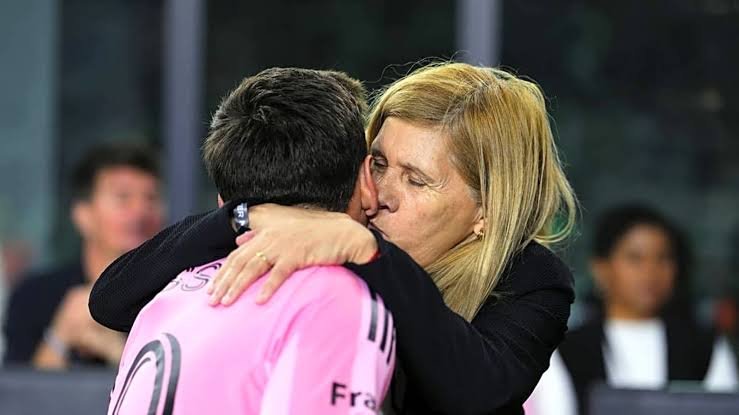
If you’ve been searching for Lionel Messi’s family background, you’ve probably come across the name Celia María Cuccittini. But beyond that name, detailed information about her life is hard to find in most sources.
This article covers what is publicly known — her identity, her roots in Rosario, the family she and Jorge Messi built together, and the close bond she shares with her famous son.
Who Celia María Cuccittini Is
Celia María Cuccittini is publicly identified as the mother of Lionel Messi — widely regarded as one of the greatest footballers in history. She is married to Jorge Messi, Lionel’s father.
One thing worth clarifying: some search results and genealogy pages mix up two people with similar names. Celia María Cuccittini is Messi’s mother. Some reports separately identify a Celia Oliveira Cuccittini as Messi’s maternal grandmother. These are two different people, and it’s easy to confuse them if you’re reading quickly.
Celia is not a public figure in her own right. She hasn’t built a public career or a media presence separate from her family. Most of the interest in her comes from one simple fact: she is Lionel Messi’s mother.
Family Roots in Rosario, Argentina
Published profiles consistently place Celia’s background in Rosario, Santa Fe — the same city where Lionel Messi was born on June 24, 1987. Rosario is Argentina’s third-largest city, sitting along the Paraná River in the central-east part of the country.
The city comes up constantly in any account of Messi’s early life. It’s where he first kicked a football, where he grew up surrounded by family, and where the early signs of his talent became clear. Because of this, Rosario and Celia’s name often appear together in biographies and family profiles of the Messi household.
It’s important not to read too much into the geographic detail. What it tells us is simply that Messi grew up in a specific place, shaped by a specific community — and that Rosario was home for the Cuccittini and Messi families.
The Messi Household — Jorge, Celia, and Their Four Children
Celia and Jorge Messi raised four children together: Rodrigo, Matías, Lionel, and María Sol. Lionel is generally described as the third child in the family.
Jorge worked as a supervisor or manager at a steel-related factory. Media profiles report that Celia worked as a cleaner and also at a magnet-manufacturing factory to help support the household. These details have been repeated widely in secondary media accounts, though they haven’t been independently verified from primary records. They’re best understood as part of a broader portrait of a working-class family doing what it needed to get by.
What comes through in almost every account of Messi’s childhood is that his parents weren’t passive observers. Both Jorge and Celia were part of a family support system that surrounded Lionel during his early years. His talent was clear from a young age, and his family helped create the conditions for it to develop.
The Decision to Move to Spain
One of the most significant events connected to Celia’s role as a mother was the family’s decision to move Lionel to Spain. As a child, Messi was diagnosed with a growth hormone deficiency. The treatment was expensive, and the family’s ability to cover the costs long-term was uncertain.
FC Barcelona recognized Messi’s talent and offered to cover his medical costs if he joined their youth academy, La Masia. This was a major decision — sending a young child to another country to pursue a football career is not a small thing for any family.
Both Jorge and Celia were part of that decision. The available accounts describe it as a family-level choice rather than something driven by one parent alone. Some reports note that Celia eventually returned to Argentina while Lionel remained in Spain with his father. That detail, if accurate, reflects just how difficult the transition was — the family was, in practical terms, split across two continents for a period of time.
It’s worth being careful not to romanticize or oversimplify this moment. What we know is that the family made a hard call, and that call had consequences that shaped Messi’s career. Whether Celia found it painful, empowering, or simply necessary — that’s something only she could say, and she hasn’t said it publicly in any widely documented way.
A Private Profile in a Very Public Story
Celia has maintained a low public profile throughout Lionel’s rise to global fame. She doesn’t regularly give interviews, doesn’t appear on red carpets, and isn’t known for statements about football or her son’s career decisions.
That’s not unusual for the parents of elite athletes. Many of them choose to stay in the background. The spotlight that follows their child is often something they observe from a distance rather than step into themselves.
For readers curious about celebrity families, coverage from outlets like Vision of Business often explores exactly this kind of dynamic — the private figures who stand behind very public success stories.
What public information does exist about Celia tends to focus on her family role rather than any independent public life. She attends matches, appears in family photos, and occasionally features in the margins of stories about her son. But she hasn’t made herself a story in her own right.
The Bond Between Celia and Lionel Messi
One of the most visible signs of the relationship between Messi and his mother is a tattoo on his arm depicting her face. Messi has spoken publicly about the tattoo in various interviews, and it’s frequently cited as a symbol of how much she means to him.
Tattoos are personal, and it wouldn’t be fair to read too much into one. But in Messi’s case, the gesture is consistent with how he presents his family in public — as central to who he is, not just as a football player but as a person.
Multiple media profiles describe the mother-son bond as close, though the details of their private relationship naturally remain private. What’s publicly visible is that Messi regularly credits his family background when speaking about his career, and his mother is part of that picture.
What We Know — and What We Don’t
It’s easy to fill an article about a private person with guesswork. But Celia María Cuccittini deserves the same care as anyone else — meaning it’s better to be honest about the limits of public knowledge than to pad out a profile with invented or unverified detail.
Here’s a simple summary of what the public record confirms or widely reports:
- She is Lionel Messi’s mother and Jorge Messi’s wife.
- Her background is placed in Rosario, Santa Fe, Argentina.
- She and Jorge raised four children: Rodrigo, Matías, Lionel, and María Sol.
- Media accounts describe her as having worked as a cleaner and in a factory — though these details come from secondary sources rather than verified primary records.
- She was part of the family decision to send Lionel to Spain to join FC Barcelona’s youth academy.
- She is not a public figure in her own right, and most information about her exists because of her famous son.
What we don’t know with confidence includes her exact birth date, her current activities, her own views on her son’s career, and most personal details about her day-to-day life. That’s not a gap in reporting — it’s a reflection of her choice to remain private.
Final Thoughts
Celia María Cuccittini is not famous in the way her son is. She didn’t score goals at the World Cup or win the Ballon d’Or. But she is part of the story that produced one of football’s most remarkable careers — as a parent, a partner to Jorge Messi, and someone who helped hold a family together through significant challenges.
The public knows relatively little about her, and that seems to be the way she prefers it. What we do know suggests a woman who played a quiet but real role in one of sport’s most celebrated families.
Also Read: